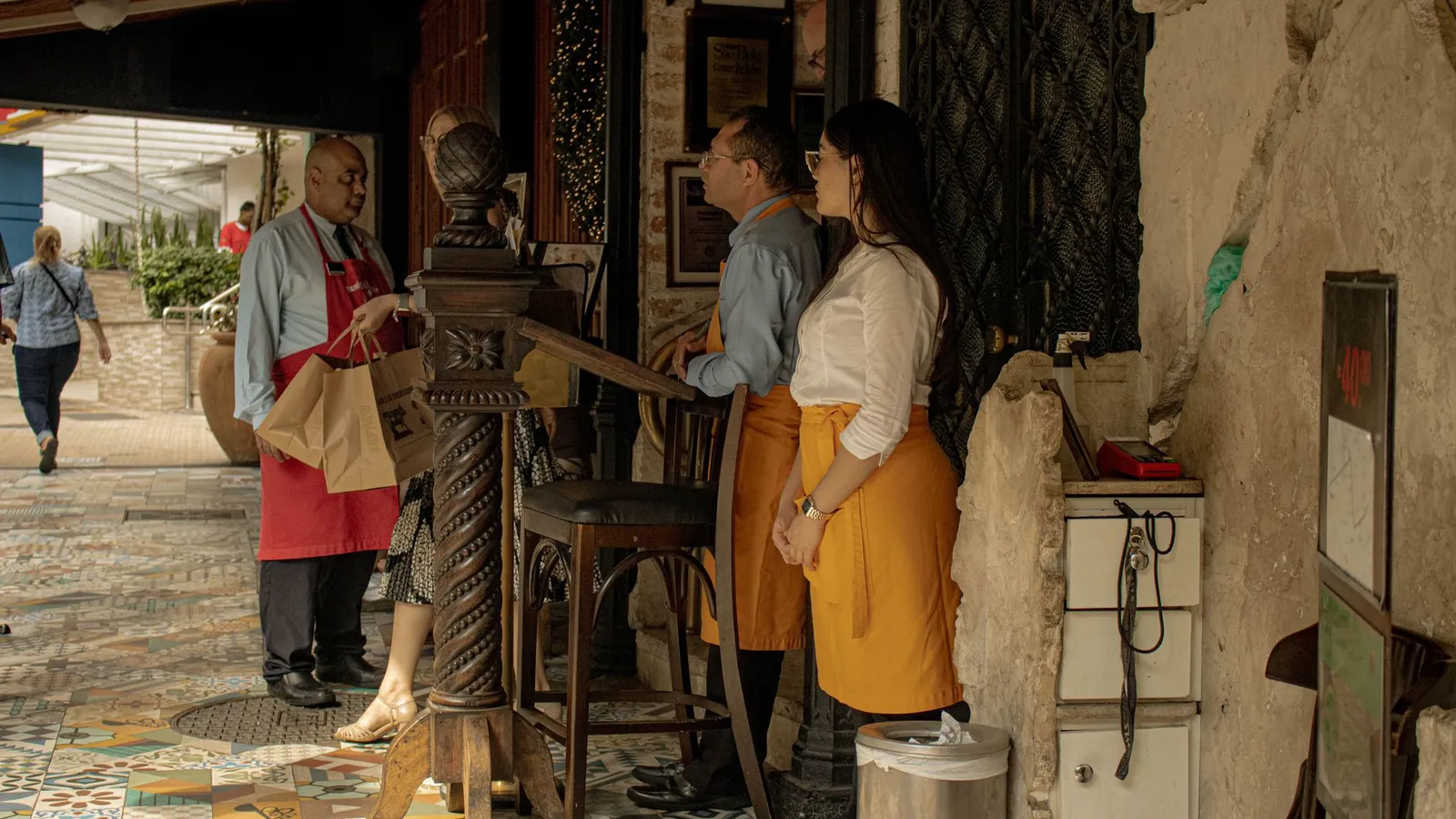
Restaurant wait time quotes as AI agents start calling in
On October 20, 2026, Yelp announced its fall product release. Two parts of it reach the host stand directly. The first is a feature called Check for Me: according to Yelp, "an AI phone agent calls the restaurant on your behalf and updates you within minutes." The second is that diners can now "join the Yelp Waitlist directly within the chat at eligible restaurants," and Yelp Assistant "will monitor your status and send you updates when your table is ready."
For a host, the practical change is simple. Once Check for Me reaches your area, the wait you quote gets sent on. A software agent asks for it, texts it to a guest who may be across town, and that guest plans their evening around it. A loose "about 20 minutes" used to stay at the door. Now it travels.
What Yelp announced, and what it did not
Here is what the Business Wire release (republished by StockTitan) and Yelp's own post state:
- Check for Me "calls a restaurant on a consumer's behalf and texts the current wait time within minutes." The diner enters a party size and a phone number, and the agent places the call.
- It is "rolling out in the coming months on eligible restaurant business pages," and Yelp's post describes it for cases "when walk-ins are possible in the U.S. on iOS."
- Yelp Assistant connects with Yelp Reservations, Yelp Waitlist, OpenTable, DoorDash and Grubhub, which Yelp describes as booking and ordering with "more than half a million restaurants."
- The release lists more than 30 new features, integrations and updates in total.
Yelp has been moving in this direction for a while. In August, Yelp announced that ChatGPT users could make Yelp reservations and join Yelp waitlists from inside ChatGPT. The release does not give an exact launch date for Check for Me. It also does not say which restaurants count as eligible, how the agent introduces itself on the call, or whether a business can opt out. If a call like this would matter to you, check your Yelp for Business account and ask your Yelp contact. Don't assume either way.
Why this is a host-stand problem, not a marketing one
A phone call asking "how long is the wait for four?" is not new. Two things change when software is making the call:
- Volume can rise without warning. Calling used to take effort, so many guests just showed up. A button that makes the call for them removes that effort, and on a busy Friday the host phone may ring more often.
- The quote comes back as text. The guest gets a number on their phone, not a tone of voice or a "should be soon." If the actual wait runs well past the quote, the guest has the original text in hand.
The fix is not a new device. It is a quote that comes from a method instead of a guess, and a phone answer that matches the waitlist screen.
A method for quotes you can defend
Most hosts quote from feel. A better approach takes about two minutes per shift to set up and uses numbers you already have: tables by size and your average turn time by daypart.
Step 1: know how often each table size opens up
If you have 8 four-tops and a Friday dinner four-top turns in about 60 minutes on average, then on a full floor a four-top opens about every 60 ÷ 8 = 7.5 minutes. That is your table release interval for four-tops on Friday dinner.
Step 2: multiply by the parties ahead for that size
A new party of four arrives with 5 four-top parties ahead of them. The base estimate is 5 × 7.5 = 37.5 minutes. Count the new party too, since they need the sixth table to open: 6 × 7.5 = 45 minutes.
Step 3: add a buffer, then round up
Turn times vary, and a large party can tie up two tables. A 10 to 15 percent buffer takes 45 minutes to roughly 50 to 52. Round to a number guests understand: quote 50 to 55 minutes. A party seated in 45 minutes is pleased. A party seated in 60 minutes after a "20 minutes" quote is not.
These figures are an example, not a benchmark. Use your own table counts and turn times from your POS or waitlist reports.
Quick reference table
| Table size | Tables | Avg turn (min) | Release interval (min) | Quote for 3rd party in line |
|---|---|---|---|---|
| 2-top | 10 | 45 | 4.5 | 3 × 4.5 = 13.5, quote 15 |
| 4-top | 8 | 60 | 7.5 | 3 × 7.5 = 22.5, quote 25 |
| 6-top | 3 | 80 | 26.7 | 3 × 26.7 = 80, quote 85 to 90 |
Print this for each daypart and tape it inside the host stand. When the phone rings, whether the caller is a person or an agent, the host reads the row for that party size and the number of parties ahead from the waitlist screen.
A phone script for wait-time calls
Keep the answer short, specific and the same as what the waitlist shows:
- Ask the party size if the caller has not given it.
- Look at the waitlist screen, not the room.
- Give a range, not a single number: "Right now about 50 to 55 minutes for four."
- Say how to hold a spot: "You can join our waitlist online or at the host stand. We don't hold spots by phone." Or whatever your actual policy is.
- Note the time of the call if your waitlist tool allows it, so you can compare quotes with actual seat times later.
The fourth point matters most. If the agent texts "50 to 55 minutes" and the guest shows up an hour later expecting to be next, your policy on holds needs to be clear on the phone, the waitlist page and the sign at the door.
Decision table: which notification fits the guest
Guests who join remotely, through Yelp's chat or a phone call, cannot carry a coaster pager. Guests standing in the lobby still can. Most restaurants will run both.
| Situation | Best notification | Why |
|---|---|---|
| Guest joined remotely and is not on site yet | Text from the waitlist system | A pager only works inside transmitter range. |
| Guest waiting in lobby, bar or patio | Coaster pager | No phone number needed. Works if their phone is dead or on silent. |
| Guest wants to walk nearby | Text, with a "reply when you're 5 minutes out" step | Covers distances beyond pager range. |
| Large party, slow-turning table | Text first, pager on arrival | Long waits reward remote joining. Arriving guests still need a local alert. |
One rule keeps the two systems in sync: when a remote guest arrives, the host checks them in on the same list and hands over a pager if they will wait on site. One list, one queue, whatever the notification method.
What text paging costs per party
Text notifications are not free, even when bundled into a subscription. U.S. carriers charge pass-through fees on business texts sent over registered 10DLC numbers. According to Telgorithm's October 7, 2026 recap, Verizon raised its outbound fee to $0.0050 per message segment on October 1, 2026, up from $0.0040 at the start of the year. T-Mobile's outbound fee rose from $0.0030 to $0.0045 on January 19, 2026, and its inbound fee was lowered from $0.0030 to $0.0025.
Worked example: a restaurant sends three texts per waitlist party (confirmation, table ready, final reminder) to 300 parties a week. That is 900 outbound messages. At the Verizon rate of $0.005, carrier fees alone come to 900 × $0.005 = $4.50 a week, or about $234 a year. Guest replies like "on our way" add inbound fees on some carriers. These are carrier surcharges only. Your waitlist vendor's own pricing sits on top, and vendors decide whether to pass these fees on. The point is not that texting is expensive. Each extra reminder has a small cost, so trim messages that do not change guest behavior.
A checklist for the next 30 days
- Check how your restaurant appears on Yelp: whether walk-ins are listed, and whether Yelp Waitlist is turned on.
- Build the release-interval table for your two busiest dayparts.
- Write a one-paragraph phone script and post it at the host stand.
- Pick one shift a week to compare quoted waits with actual seat times. If the gap is more than 10 minutes on average, adjust your turn-time figures.
- Make sure remote joins and walk-ins land on one list, with pagers handed out to on-site guests.
- Count texts per party and drop any that do not change what guests do.
If you run KwickPOS, it lists Wait List/Reservation among its features; check with your KwickPOS contact how it fits a single-list setup. Whatever system you use, the goal is the same: the number a guest gets, from a host, a pager or an AI agent's text, should come from the same queue.
Frequently asked questions
What is Yelp's Check for Me feature?
Yelp announced it on October 20, 2026. Yelp describes it as an AI phone agent that calls a restaurant on a diner's behalf and texts them the current wait time within minutes. The diner enters a party size and a phone number first. Yelp says it is rolling out in the coming months on eligible restaurant pages, in the U.S. on iOS, where walk-ins are possible.
Can a restaurant opt out of AI wait-time calls?
Yelp's announcement does not say. Check your Yelp for Business settings or ask Yelp directly rather than assuming either way.
How should a host calculate a wait quote?
Divide the average turn time by the number of tables of that size to get how often a table opens up. Multiply by the number of parties waiting for that size, including the new party, then add a 10 to 15 percent buffer and round up to a range.
Do coaster pagers still make sense if guests can join a waitlist remotely?
Yes, for guests waiting on site. A pager needs no phone number and works when a phone is dead or on silent. Guests who join remotely need a text, because they are outside pager range. Keep both groups on one waitlist.
How much do waitlist text messages cost in carrier fees?
According to Telgorithm, Verizon's outbound 10DLC fee became $0.0050 per message segment on October 1, 2026, and T-Mobile's outbound fee is $0.0045. At three texts per party and 300 parties a week, that is about $4.50 a week in carrier fees at the Verizon rate, before any vendor pricing.
Sources
- Do more on Yelp: Smarter AI answers, seamless reservations, and automated tools for businesses (Fall product release 2026), Yelp (official blog), 2026-10-20
- Yelp Announces More Personalized Yelp Assistant, Agent that Checks Restaurant Wait Times and AI Tools for Service Professionals (Business Wire release, republished), Yelp Inc. via Business Wire / StockTitan, 2026-10-20
- 10DLC Carrier Fee Increases in 2026: Year-to-Date Recap, Telgorithm, 2026-10-07
- KwickPOS home page (Wait List / Reservation feature listing), KwickPOS
Checked November 3, 2026. Photo: Giovana Montes Furlan / Pexels.
Turn event traffic into pager evidence
After a major crowd, count what happened: range failures, dead batteries, missing units, delayed returns, and staff handoff gaps. That is the hardware plan for the next surge.